|
|
 |
|
|
|
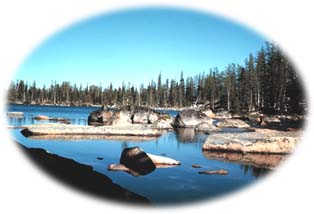 Cathedral Provincial Park is a beautiful alpine area within easy reach of Vancouver. As a result, it is a favorite escape for urbanites looking for a long weekend wilderness getaway. The park was created to preserve its unique and spectacular landscape. Five sparkling turquoise lakes 2000 m (6,500 ft) above sea level, alpine meadows, and fascinating geological formations make Cathedral a perfect place for hikers to explore. The gentler alpine terrain makes Cathedral well suited for families. Cathedral Provincial Park is a beautiful alpine area within easy reach of Vancouver. As a result, it is a favorite escape for urbanites looking for a long weekend wilderness getaway. The park was created to preserve its unique and spectacular landscape. Five sparkling turquoise lakes 2000 m (6,500 ft) above sea level, alpine meadows, and fascinating geological formations make Cathedral a perfect place for hikers to explore. The gentler alpine terrain makes Cathedral well suited for families.
|

Cathedral Park is located approximately 30 km (19 mi) southwest of Keremeos and 48 km (30 mi) south of Princeton. It takes approximately 5 hours to drive to Keremeos from Vancouver by way of the Trans-Canada Highway (Highway 1) and Highway 3. From Keremeos a 25 km (16 mi) one hour drive south on the rough gravel Ashnola River Road leads to the Cathedral Lakes Resort parking lot.
|
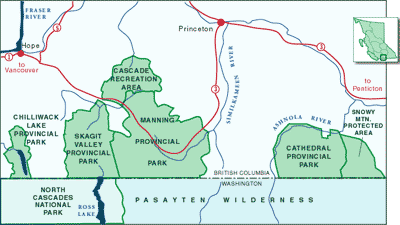
Click on the map to view an enlargement
Private vehicles are not permitted beyond the parking lot. To get to the core of the park visitors must back-pack up a 16 km (10 mi) long mountain trail. Alternatively, Cathedral Lakes Lodge runs a jeep service, that transports visitors to the core area, but this must be pre-arranged. Both the trail and the jeep leave from the main parking lot.
|
"Cathedral Provincial Park is one of the most beautiful spots close to Vancouver and a favorite escape for urbanites who are looking for a long weekend wilderness getaway."
|

Cathedral includes several different ecosystems. At the lower elevations dryland Douglas fir forests, interspersed with aspen and cottonwood, dominate. Continuing higher, lodgepole pine and Engelmann spruce take over, and are in turn replaced by subalpine fir, larch, and subalpine meadows with a multitude of heathers and wildflowers. The park is popular for its 200 species of flowers that bloom in the summer. This diversity allows the park to be home to a wide range of animal and plant species. The most common wildlife in Cathedral Provincial Park are California Bighorn sheep, mule deer, mountain goats, porcupines, hoary marmots, and Columbia ground squirrels. Black bears do exist, but are a rarely seen in the park.
|

Cathedral Park is a popular destination for camping, hiking, paddling, fishing, mountaineering, and cross-country skiing. This wide range of activities is possible because of the diverse climates and altitudes contained within the park.
The area has 32 km (20 mi) of well-marked hiking trails leading to beautiful alpine ridges, azure lakes, and high mountain peaks such as 2551 m (8370 ft) Quiniscoe Mountain. Cathedral's mountains are part of the Okanagan Mountain Range. A trail brochure is available from the park warden, who lives in a cabin next to the Cathedral Lakes Lodge. 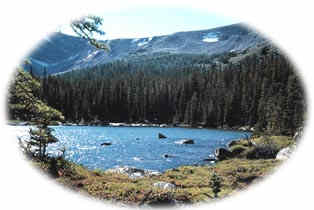 This brochure provides detailed information on trails including their length, elevation, and difficulty. Most of the trails are manageable for people of average fitness levels. This brochure provides detailed information on trails including their length, elevation, and difficulty. Most of the trails are manageable for people of average fitness levels.
One such trail is the Cathedral Rim hike, which leads to the lovely aquamarine Lady Slipper Lake, as well as to see the major geological features of the park. Fascinating and massive rock formations made from quick cooling lava are dispersed throughout Cathedral. Smokey-the-Bear, Stone City, the Giant Cleft, and the Devil's Woodpile are but four of the features that make exploring this area an adventure.
There are 16 vehicle/tent campsites at the Lakeview Trail Campground. Within the park's core there are approximately 70 wilderness/walk-in backcountry camping sites, with no facilities offered except pit toilets. Near some of the more popular lakes, camping is restricted to designated sites. For those who don't want to rough it, Cathedral Lakes Lodge at Quiniscoe Lake provides food and accommodation for up to 50 people.
|
"Smokey-the-Bear, Stone City, the Giant Cleft, and the Devil's Woodpile are but four of the geological features that make exploring this area an adventure."
|

The park is named after 2800 m (9184 ft) high Cathedral Mountain. There are no known archaeological sites in the park, but research indicates that First Nations peoples from the Okanagan and Similkameen valleys hunted the alpine ridges in search of hoary marmots. More recently, the park's landscape was made famous in the filming of the 'Clan of the Cave Bear'.
Cathedral Park was first proposed for protection in the 1940s by the BC Naturalist's Association, but the proposal only gained momentum in the late 1960s under the leadership of the Okanagan-Similkameen Parks Society. By the early 1970s, a park of 7,690 ha (19,000 acres) had been established. Further citizen activism led to an expanding of this park to about 33,000 ha (81,500 acres) in the mid 1970s.
Several other parks are linked to Cathedral. The newly created Snowy Crater Park (26,000ha/65,000acres) links to Cathedral in the west, while to the south is the Pasayten Wilderness (0.2 million ha/0.5 million acres) in the USA. (Pasayten in turn connects to North Cascades National Park (still in the USA), and Manning and Skagit Parks in Canada.) This complex of parks creates one vast preserve for wildlife and biodiversity to thrive in. At 1.2 million ha (2.9 million acres) overall, this transboundary complex is the largest expanse of preserved wilderness along the Canada/US 49th parallel.
|
|
Return to the Okanagan Region
Become Involved!
|
|
|
|