|
The coastal rainforests are among the rarest and most productive ecosystems on the planet; they are also disappearing before we know almost anything about them. It's as if we are burning the library before we have read the books. Only in the last 10 years have scientists begun to learn about the fragile system of interrelationships that makes up the beautiful web of life in these "green cathedrals". In the meantime salmon, which our fisheries as well as a multitude of other animals depend upon, are disappearing forever along with many other species that can live only in coastal rainforests.
The temperate rainforest is very rare, originally covering less than 0.2% of the earth's land surface. Now, over one half of that limited original temperate rainforest has been logged and altered; of that which remains worldwide, over one quarter is found on BC's coast.
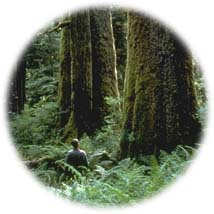 Recently environmental organizations have been able to turn the spotlight of international concern to BC's rainforests. Efforts to protect such 'Great Spaces' as the Kitlope and Great Bear Wilderness, have become internationally known as have the Queen Charlotte Islands' Gwaii Haanas, and the Walbran Valley. Recently environmental organizations have been able to turn the spotlight of international concern to BC's rainforests. Efforts to protect such 'Great Spaces' as the Kitlope and Great Bear Wilderness, have become internationally known as have the Queen Charlotte Islands' Gwaii Haanas, and the Walbran Valley.
But time is running out. So far only 5.8% of BC's ancient rainforests have been protected and much of the rest has been scheduled to be clearcut in the next decade.
According to the respected Washington DC based World Resources Institute: "The Earth's last frontier forests may indeed be the most valuable gift we can leave for our children. Guardians of biodiversity, indigenous cultures, and ecological processes, frontiers also provide recreational and ecotourism opportunities. Because so many irreplaceable forests have already disappeared, the worth to future generations of those that remain is greater than ever."
|






























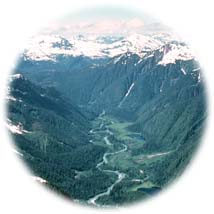 coastal rainforests which enthrall visitors from throughout the world, it is the productiveness of these forests that intrigue scientists. BC's coastal rainforests feature the highest biomass (the total amount or mass of organisms in a given area) per hectare of any ecosystem on earth. Trees here can often live more than 1,000 years, reaching hundreds of feet into the air, with diameters exceeding 9.4m (31 ft).