WHAT'S IT LIKE TO CATCH A STEELHEAD?Steelhead are the ultimate North American freshwater sport fish. Thirty pounds of fighting spirit, this sea-run rainbow trout returns to spawn in the waters of its birth like a salmon. Clean, fresh rivers with deep pools to hole up in, that is where steelhead lurk.
They are beautiful creatures: blue-green backs, crimson flanks, silver underneath, strong heads, and oversize tails. Steelhead are built for endurance and strength, requirements necessary to make their long upriver return to ancestral spawning beds. These fish are an elite catch. They don't give up without a fierce, prolonged battle. Once hooked, the muscled, full-bodied males dive deep in the backwater, lashing in a powerful tug-of-war. The females react with a more frenzied leaping, ricocheting off the wave tops to try to break away. And many times an angler will flycast the pools and riffles, hooking into a big steelhead finally, playing the line inward and back out for an hour, only to have the fish escape.
"Steelhead are the ultimate North American freshwater sport fish."
For the river fisherman the experience of catching a 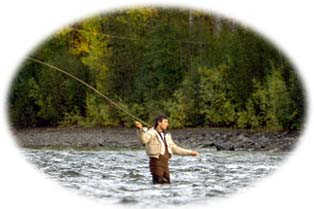 steelhead is legendary, something that is only partly due to the animal's feistiness. Steelhead rivers have always been small in number on North America's West Coast. Just getting to a steelhead stream is still no guarantee you will catch your quarry. Both skill and luck are required, which adds to the challenge and the fish's mystique. Indeed, merely finding a steelhead can be tricky. First, you have to get intimate with the river, learning its currents, channels, and pools. Then perhaps you can locate exactly where the fish skulk. steelhead is legendary, something that is only partly due to the animal's feistiness. Steelhead rivers have always been small in number on North America's West Coast. Just getting to a steelhead stream is still no guarantee you will catch your quarry. Both skill and luck are required, which adds to the challenge and the fish's mystique. Indeed, merely finding a steelhead can be tricky. First, you have to get intimate with the river, learning its currents, channels, and pools. Then perhaps you can locate exactly where the fish skulk.
Once you have found them, then they must be enticed, which means figuring what insects they are eating that day and choosing or tying a fly to mimic, to lure. Ultimately it comes down to having the graceful artistry to cast this morsel precisely and present it just so. Then, after a great deal of trying, if you are especially fortunate, a steelhead might bite. Maybe.
But once hooked, there can be no uncertainty. The subsurface strength that yanks and yards is obvious. Your line races out, the reel singing, the rod tip flexing wildly. Then, for as long as it takes, you and the steelhead dance in primal choreography, tethered together by nylon monofilament. Even when you stand with rubber hip waders on in waist-deep water, your legs feel cold. The pulling on your arms is rough and emphatic. Again the fish streaks away with the line, only to be reeled once more carefully inward. Out, then back, out, then back, breaking now to the side and then jumping high. And so it goes, one thrilling minute after another.
The skill required to land a steelhead demands strategy, patience, strength, and finesse. If you have all these talents, and chance is also with you, then you might possibly bring the warrior to shore. Leaning down to stream level, you cradle the grounded giant, now gone quiet from fatigue. Holding the fish close in your arms, you can feel its life force. This is a magical moment, the reason for your passion. And always you never fail to be amazed at how large and vital a steelhead is.
"Then, after a great deal of trying, if you are especially fortunate,
a steelhead might bite. Maybe."
Carefully you remove the barbless hook from its mouth. Ecstatic, your heart still pounding, perhaps you have a picture taken even as your trophy washes in the water. You stroke this river wonder almost lovingly and rock it gently, gills forward to the current. For a moment time stands still. All motion is suspended. But too soon the spell is broken. With a shudder the creature reasserts its life, muscled tension rippling through firm flesh. The great tail thrashes powerfully as you ease your embrace. And then with strength renewed the steelhead rockets forth into pure, fresh waters. Free once more.
Quite simply, river fishing doesn't get any better than matching wits with these prize fighters in wilderness waters. As a result, over the years the steelhead's reputation spread. Increasingly anglers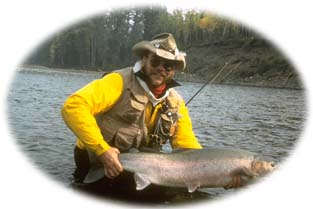 began coming from around the world to the Pacific coast to try their luck. But even as the fame of the great fish grew, its habitat was already being lost. Where originally rivers from Baja to Alaska had supported runs, decades of dam building and development forced the wild populations in the United States and Mexico toward extinction. Only in British Columbia did the species remain strong, making this place the world Mecca for steelhead fishermen. began coming from around the world to the Pacific coast to try their luck. But even as the fame of the great fish grew, its habitat was already being lost. Where originally rivers from Baja to Alaska had supported runs, decades of dam building and development forced the wild populations in the United States and Mexico toward extinction. Only in British Columbia did the species remain strong, making this place the world Mecca for steelhead fishermen.
Yet such distinction didn't remain unthreatened for long. By the 1970s and early 1980s, the tragic pattern of steelhead decimation had crossed the border. With each passing year destruction of the runs crept northward up the British Columbia coastline. On Vancouver Island the once-famed Cowichan, Campbell, and Puntledge Rivers came under assault from mining pollution, urban settlement, and especially logging. With each West Coast rain, soil eroded from clearcuts further clogged spawning gravel and suffocated ever more steelhead eggs. Quickly the runs declined.
"With each passing year destruction of the [steelhead] runs crept
northward up the British Columbia coastline."
Only on the BC north coast, and particularly in the Skeena watershed, did the steelhead populations still seem healthy. But even here old-timers said the fishing wasn't what it had once been. The blue-ribbon Kispiox River started to feel the impact of industrial forestry, as did the Morice and Bulkley Rivers. With each passing year the number of cutblocks increased, more miles of logging roads were built, and the silt loads entering the waterways rose. As had been the case all up the western seaboard, it was the steelhead that paid the mortal price of such development. The situation continued to worsen until by the late 1980s only one major BC steelhead stream remained in pristine wilderness health - the Babine River.
To learn more on how and why the Babine River has remained wild, please visit the Babine River Corridor Provincial Park page.
|