|
|
|
|
|
|
|
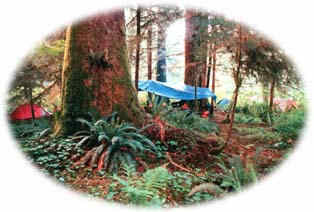 British Columbia's Carmanah Walbran Park is a majestic, awe inspiring, magical, and intensely spiritual sanctuary. Ancient, moss coated forests stand undisturbed, a silent escape from today's fast paced modern world. British Columbia's Carmanah Walbran Park is a majestic, awe inspiring, magical, and intensely spiritual sanctuary. Ancient, moss coated forests stand undisturbed, a silent escape from today's fast paced modern world.
From a scientific point of view, this ancient temperate rainforest generates awe as well. The richness and complexity of the region is exceptional. Although tropical rainforests are well known for their ecological diversity, North America's temperate rainforests contain nearly twice as much biomass (the total amount, or mass, of organisms in a given area) as tropical rainforests. Unfortunately these incredibly rich forests are quickly disappearing because of logging and the spread of urbanization. BC is home to some of the last great samples of temperate rainforest in the world, and Carmanah Walbran is one of the best examples.
The park's untouched wilderness, on the wild west coast of Vancouver Island, has become internationally known for its role in preserving the largest known Sitka spruce trees in the world. It is home to the Carmanah Giant; at 95 m (313 ft) it is the world's tallest Sitka spruce. The fact that there are more than 200 very old growth Sitka spruce here is significant alone, as such spruce trees have very particular needs and grow only in 2% of BC's forests. These giants tower like skyscrapers, often 70 m (230 ft) high and 9.4 m (31 ft) in circumference. Carmanah Walbran is also home to massive western red cedars, some almost 1,000 years old.
|
"Carmanah Walbran Park is a majestic, awe inspiring, magical, and intensely spiritual sanctuary."
|

Carmanah is located on the southwest coast of Vancouver Island, 20 km (12 mi) northwest of Port Renfrew, and south of Bamfield. It is adjacent to Pacific Rim National Park, location of the famous West Coast Trail. The only established park facility, a campground with tent sites and drinking water, is located in the Lower Carmanah Valley. As the Walbran Valley is primarily a nature preserve, it has no developed trails, facilities or campsites.
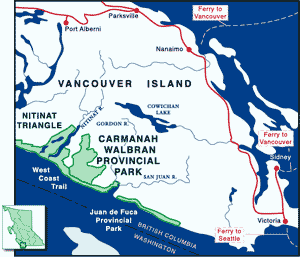
Click on the map to view an enlargement
|

The Carmanah Walbran encompasses 16,450 ha (41,000 acres) of ancient rainforest comprised of western hemlock, western red cedar, amabilis fir, Sitka spruce, and yellow cedar. The lush habitat created by the nutrient rich ocean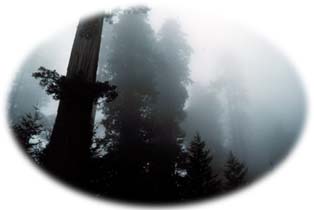 spray and constant rainfall (over 350 cm/138 inches a year) supports a wide variety of wildlife including wolves, cougars, marten, mink, black-tail deer, and bears. The rivers and streams contain chinook and coho salmon, cutthroat and steelhead trout. The most commonly seen birds include northern flickers, hairy woodpeckers, winter wrens, ravens, eagles, varied thrushes, red-breasted sapsuckers, pigmy owls, and barred owls. spray and constant rainfall (over 350 cm/138 inches a year) supports a wide variety of wildlife including wolves, cougars, marten, mink, black-tail deer, and bears. The rivers and streams contain chinook and coho salmon, cutthroat and steelhead trout. The most commonly seen birds include northern flickers, hairy woodpeckers, winter wrens, ravens, eagles, varied thrushes, red-breasted sapsuckers, pigmy owls, and barred owls.
The Carmanah Walbran has become famous not only because of the immense size of its old growth spruce, but also because of the endangered marbled murrelet, a bird that requires old growth forests and high cliffs in which to build their nests. Until recently, the life of a marbled murrelet was a mystery. Less than two dozen nests were known to exist world-wide and none were known in BC. Then, in August 1990, Western Canada Wilderness Committee sponsored a team of researchers in Carmanah Walbran who discovered a nest in the Walbran Valley. This discovery makes this pristine wilderness area that much more important to preserve for all time.
|
"The Carmanah Walbran encompasses 16,450 ha (41,000 acres) of ancient rainforest comprised of western hemlock, western red cedar, amabilis fir, Sitka spruce, and yellow cedar."
|

A rudimentary 20 km (12 mi) trail system was built by volunteers, initially organized by the Western Canada Wilderness Committee, making the park's old growth forests easily accessible to the public. It takes approximately an hour to hike from the trailhead into the valley where the luxuriant growth of towering Sitka spruce and red cedar, moss, salal, deer fern, and huckleberries begins. Massive brown, yellow, and even purple mushrooms spring from the damp forest floor. But remember this area is called a rainforest for very good reason; expect to get very wet at any time of the year.
Unfortunately, this historic natural cathedral is in danger of being loved to death. 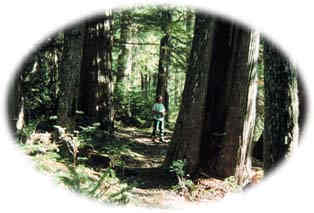 It is a sensitive ecosystem. For example, the root systems of Sitka spruce often extend above the surface. Trampling by visitors is damaging the trees' support system. Please stick to established trails and only pitch tents on dry gravel beds. Practice the 'leave no trace' philosophy. Carry out garbage, don't bury it, and don't try to hack a way through the extensive undergrowth. It is a sensitive ecosystem. For example, the root systems of Sitka spruce often extend above the surface. Trampling by visitors is damaging the trees' support system. Please stick to established trails and only pitch tents on dry gravel beds. Practice the 'leave no trace' philosophy. Carry out garbage, don't bury it, and don't try to hack a way through the extensive undergrowth.
Please respect the few areas that have been roped off in order to protect the most vulnerable old giants. The Carmanah Giant in particular is in danger, and reaching it is an extremely strenuous trek. Hikers are recommended to visit other, equally awe inspiring, tall trees such as the Carmanah Triplets and Spruce Grove in the central part of the valley. A visit to Carmanah should be treated as a spiritual pilgrimage, for that in essence is what it is.
|
"These forests are quickly disappearing every year, and BC is home to some of the last great archives of temperate rainforest in the world."
|

The Carmanah Valley in southwestern BC was considered for a long time to be too remote to log, and therefore escaped the interest of the forest industry. It wasn't until Randy Stoltman found some of the oldest and largest Sitka spruce trees in the world, that the Carmanah Valley caught the forest industry's attention. Fearing a repeat of the Nitinat Triangle and Clayoquot Sound controversies, the forest industry tried to proceed rapidly to log Carmanah.
But citizen blockades and opposition led by the Western Canada Wilderness Committee were so effective that eventually the provincial government protected the lower half of the Carmanah Valley adjacent to Pacific Rim National park in 1990. After continued protest from environmentalists and the public, the Walbran and upper Carmanah valleys were added five years later.
This is a classic story of one individual, in this instance Randy Stoltman, raising awareness of the lands he loved. By engaging the energy of environmental groups and the broad support of the public, Carmanah was protected. It is the work of individuals rallying others to the cause that has resulted in the creation of most of the parks in BC and beyond.
|
Return to the Vancouver Island Region
Become Involved!
|
|
|
|